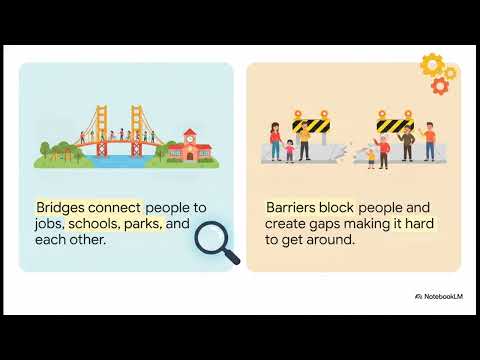
Over the next three weeks, you'll think like an engineer and a community planner — exploring what makes bridges strong, and how bridges (and barriers) shape who can get where in a community. This week, it's time to become a Bridge Engineer!

Last week, you became a Bridge Builder and discovered a big secret: a flimsy sheet of paper gets strong when you change its shape. You tested flat bridges and shaped bridges, and you started spotting the bridges and connections all around your neighborhood. This week, it's time to become a Bridge Designer!

Over the next three weeks, your family will explore bridges — how they are built, why their shape matters, and all the ways bridges connect the people and places in our lives. This week, it's time to become a Bridge Builder!

In this activity, your family will design and build your own mini Rube Goldberg machine using simple, everyday materials from around the house, things like cardstock, straws, craft sticks, toilet paper rolls, dominoes, and marbles.
What is a Rube Goldberg machine? It's a machine that uses a long, silly chain of steps to complete a simple task!

In this activity, your family will build a marble maze together using simple household materials — straws, tape, and a paper plate — then take turns experiencing the maze from different points of view.

Last week, you explored your neighborhood through the eyes of an urban planner, observing public spaces, identifying community strengths, and documenting challenges that affect the people who live there. This week, you'll take the next step.
Last week, you became a Nature Detective by exploring your neighborhood, park, or outdoor space. You observed plants, animals, insects, and other living things, asking questions and recording your discoveries in your Nature Detective Notebook. This week, it's time to become a Nature Helper!

This week, kids will become Community Designers by exploring their neighborhood through the eyes of urban planners, engineers, architects, and community leaders.

This week, kids will become Nature Detectives by exploring a local park, neighborhood, backyard, or outdoor space. Together, you'll practice looking closely, asking questions, and making observations about the living things around you.
In this engineering challenge, kids will design a space lander that protects a passenger during a landing. Through testing and redesigning, students will explore how forces like gravity and drag affect motion and how engineers use creativity, experimentation, and problem-solving to overcome challenges.

Did you know the sun provides the energy that powers nearly all life on Earth? In this activity, kids will design and build a simple solar oven using household materials to investigate how sunlight transfers heat energy. They can even use it to make s’mores! 🍫

Have you ever seen a maple seed spinning through the air like a tiny helicopter? In this activity, kids can create their own paper “helicopters” inspired by real maple tree seed pods — also known as “helicopter seeds.”

Big feelings are a normal part of growing up — and sometimes, it can be hard for kids to find the words to express exactly how they feel. In this fun and creative activity using materials found at home, kids will create “emotion masks” that help explore feelings through art, color, imagination, and conversation.

In this challenge, kids will become engineers and see how tall of a tower they can build using only simple materials. There is no single correct answer—every tower will be different!
